


How to Choose the Right Business Class Seat for a Long-Haul Flight
Sep 23, 2026Booking Business Class is only half the decision. The other half is choosing the right seat.
On a long-haul flight, the difference between two Business Class seats can be surprisingly significant. One may offer a private window, direct aisle access and a quiet environment for sleeping. Another may be closer to the galley, exposed to foot traffic or positioned next to a lavatory.
The important thing to understand is that Business Class is not a single product. The same airline can operate several aircraft with completely different Business Class cabins, and the seat you receive depends on the aircraft and configuration assigned to your flight.
For flights of eight, ten or twelve hours, checking the seat map before booking can make as much difference as choosing the airline itself.
Start With the Aircraft, Not the Seat Number
1.webp)
One of the most common mistakes is looking at the seat map only after buying the ticket.
Instead, start by checking which aircraft operates your flight.
An airline may have a modern 1-2-1 Business Class cabin on one aircraft and an older 2-2-2 configuration on another. Even within the same airline, Business Class can therefore offer very different levels of privacy, aisle access and sleeping comfort.
This is particularly important in 2026, when many airlines are still introducing new Business Class seats while older cabins remain in service.
The aircraft type is usually displayed during the booking process. Once you know it, check the exact seat configuration rather than assuming that every Business Class cabin from that airline is identical.
A useful rule is simple:
Don't book the airline. Book the aircraft and the seat.
Understand the Business Class Layout
1.webp)
Before choosing an individual seat, identify the cabin configuration.
1-2-1: The Modern Standard
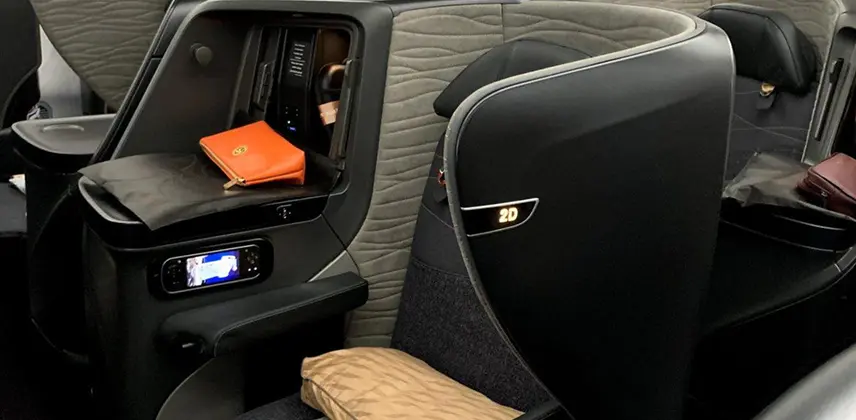
For long-haul Business Class, a 1-2-1 configuration is generally the easiest layout to work with because every passenger has direct access to the aisle.
That means you can get up during the flight without disturbing another passenger.
Modern 1-2-1 cabins can take several forms, including reverse herringbone, staggered seating and enclosed suites. They are not identical, but they share one important advantage: direct aisle access.
For solo travelers, this is usually the first thing to look for.
2-2-2: Think Twice
Older 2-2-2 Business Class cabins can still be comfortable, especially when traveling with a partner.
The problem is the window seat.
If you are sitting next to the window, you may need to climb over your seatmate to reach the aisle. On a short daytime flight this may be tolerable. On a twelve-hour overnight flight, it becomes considerably less convenient.
If you are traveling alone and your aircraft has a 2-2-2 configuration, an aisle seat is usually the more practical choice.
For couples, however, the middle pair can be attractive because you can sit next to each other without someone between you.
Window or Aisle?
Once you've identified the configuration, the next decision is personal preference.
Choose the Window for Sleep and Privacy
A window seat is usually the natural choice if your priority is sleeping.
You have a wall beside you, fewer people passing directly next to your seat and control over the window shade.
In many modern Business Class cabins, window seats also provide considerably more privacy than center seats.
Some aircraft take this further with individual suites and privacy doors. Qatar Airways' Qsuite, for example, combines direct aisle access with a closing door, while other modern products use high seat shells to create separation without completely enclosing the passenger.
For an overnight flight, a private window seat can feel closer to a small personal cabin than a conventional airline seat.
Choose the Aisle for Freedom
The aisle seat is better suited to travelers who move around frequently.
If you regularly get up for the bathroom, like to walk during long flights or simply dislike feeling enclosed, direct aisle access is particularly valuable.
It is also useful if you are working during the flight and expect to get up regularly.
The trade-off is exposure to the aisle. Cabin crew and passengers will occasionally pass close to your seat, and you lose some of the cocoon-like feeling of a window position.
In a modern 1-2-1 cabin, however, the difference between window and aisle is much smaller than it used to be because both positions can provide direct aisle access.
The Best Seats for Solo Travelers
1.webp)
If you're traveling alone, look for a seat that maximizes privacy.
In many reverse-herringbone configurations, window seats are particularly attractive because the seat is angled away from the aisle and the surrounding shell creates a natural sense of separation.
Staggered configurations can also provide excellent privacy, although the exact experience varies by aircraft.
If the cabin has individual suites with doors, the choice becomes even simpler: prioritize the window-side or solo-facing seats if you want maximum privacy.
The key is not simply seeing "1-2-1" on the seat map.
Look at the actual position of the seat.
Two 1-2-1 cabins can feel completely different.
The Best Seats for Couples
1.webp)
Traveling with a partner changes the equation.
If you want to talk during the flight, center seats can be preferable in a 1-2-1 configuration, provided the seats are positioned close enough together.
Some Business Class products deliberately offer paired center suites. Qatar Airways' Qsuite is an extreme example, with configurations that can accommodate couples and, on selected aircraft, larger groups traveling together.
Other cabins prioritize privacy, meaning the center seats may feel surprisingly separated even though you are sitting next to each other.
Before choosing two seats together, check the actual seat design rather than relying only on the letters or seat numbers.
Pay Attention to the Distance From the Galley
The front row of Business Class often looks attractive.
Nobody is sitting directly in front of you, and there can be a greater sense of space.
But the first row is not automatically the quietest.
Depending on the aircraft, the galley or lavatory may be directly ahead or nearby. Cabin crew may prepare meals there, passengers may queue nearby and doors may open and close throughout the flight.
The same applies to the final rows of the cabin.
A seat directly beside a galley or lavatory can experience more movement and noise than one located in the middle of the Business Class cabin.
For overnight flights, the quietest seat is often not the first or last seat in the cabin, but one located away from these high-traffic areas.
Avoid the Lavatory When Sleep Matters
This sounds obvious, but it is easy to miss on a seat map.
A seat may appear excellent because it is a window seat with direct aisle access, but if the lavatory is directly behind it, the experience can be very different.
During a long overnight flight, passengers will regularly use the bathroom.
You may hear doors opening, footsteps and conversations, while the area can become a gathering point during busy periods.
If your priority is sleep, look for a seat that is separated from both the lavatories and galleys.
Check the Direction of the Seat
Not every Business Class seat faces directly forward.
Herringbone and reverse-herringbone designs position passengers at an angle, while staggered configurations can alternate the orientation of seats.
This matters more than it initially appears.
A seat facing the window can feel extremely private, while another position in the same cabin may leave you facing toward the aisle.
If you dislike unusual sleeping positions or prefer a conventional forward-facing bed, check the seat diagram carefully before booking.
The configuration itself is often more informative than the airline's marketing description.
Don't Assume Every Lie-Flat Seat Is Equally Comfortable
A seat that converts into a completely flat bed is a major advantage on long-haul flights, but "lie-flat" does not automatically mean identical comfort.
Pay attention to:
- bed length
- seat width
- footwell size
- shoulder space
- mattress or bedding
- storage
- privacy
- sleeping direction
- access to the aisle
For a 10- or 12-hour overnight flight, these details become more important than the size of the entertainment screen or the appearance of the seat.
A modern Business Class seat should be evaluated as a bed as much as a chair.
The Aircraft Can Change Your Decision
There is another reason to check the aircraft carefully: airlines frequently operate multiple Business Class products.
Lufthansa is a good example. Its newer Allegris Business Class seats are available on selected A350s and 787-9s, while older Business Class configurations continue to operate elsewhere.
Emirates has also been transitioning parts of its fleet to newer Business Class configurations, meaning the same airline can offer significantly different seats depending on the aircraft.
This is why the phrase "I flew Business Class with X airline" doesn't necessarily tell you what the next passenger will experience.
The aircraft matters.
A Simple Seat-Selection Checklist
Before confirming your seat, ask seven questions:
1. Is the seat fully lie-flat?
For a long-haul overnight flight, this should be one of your first checks.
2. Does it have direct aisle access?
If not, consider whether you're comfortable disturbing your seatmate.
3. Is it a window, aisle or center seat?
Choose according to whether you prioritize privacy, mobility or traveling together.
4. Is it close to a galley?
If sleep is important, distance from service areas can matter.
5. Is it close to a lavatory?
Avoid high-traffic areas when possible.
6. Does the seat have good privacy?
Look at the actual position of the seat, not just the 1-2-1 label.
7. Is this definitely the aircraft operating my flight?
This is perhaps the most important question.
If the answer to the last question is uncertain, don't assume the seat map you are looking at represents the final product.
What Seat Should You Choose?
There is no universal "best Business Class seat."
Instead, there is a best seat for the way you travel.
If you're flying overnight and want to sleep, prioritize a private window seat away from the galley and lavatories.
If you want freedom to move around, prioritize direct aisle access.
If you're traveling as a couple, investigate the center seats and whether they are designed for interaction.
If privacy matters most, look for an enclosed suite or a highly private 1-2-1 configuration.
And if you're tall, pay particular attention to bed length and footwell design rather than simply choosing the most attractive-looking seat on the map.
The most important lesson is that Business Class is not defined by the ticket category alone. It is defined by the specific seat you actually occupy.
Before booking your next long-haul trip, compare the aircraft, cabin layout and seat map alongside the fare itself. A few minutes of research can determine whether your ten-hour flight feels like a comfortable private space or simply a more expensive airline seat.
When the right seat matters as much as the destination, choosing the right aircraft is the first step. From there, you can compare available Business Class flights with PrivyTrips and look for Business Class flight deals that combine the cabin you want with the route and schedule that work for your trip.


4.webp)

1.webp)



Subscribe to Our Newsletter
Sign up for our newsletter and be the first to know about our latest exclusive offers that you won't find online.


